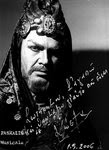
Showing posts with label Dolora Zajick. Show all posts

Tuesday, September 29, 2009

Povera Rigoletta


In October's issue of OperaNews, Louis T. Guinther asks 9 Divas to share some of the offers they found impossible not to refuse.

Dolora Zajick has been asked to play Rigoletta
(Gilda's mother - huh?)

Reri Grist was asked to sing Salome
("Salome? Salome!! – Yes! Yes, I would! — if only I had been born with a different pair of vocal cords!")

JoyceDiDonato was offered Leonore in Fidelio
("I'm not sure whether heavy drugs were involved or not, but I politely declined and made a mental note to always remember that crazy offer.")

Renée Fleming was asked by sir Georg Solti to record Isolde
("it was wonderful to be asked!" - what a lost chance for mankind!)


Marilyn Horne was also someone else´s ideal Salome
("Besides, I didn't have the thighs for that role anyway")
and a tenor arias album
("Even I have my limits")

Carol Vaness was asked by sir Georg Solti to sing
all 3 female roles in Die Frau Ohne Schatten
("Then he offered me the Färberin, and I said, well, if the other was too big then certainly the bigger one was way big")

Evelyn Lear was one more Salome candidate
("After I sang through it for him, von Karajan said, "Du bist mein Salome!")

Jennifer Larmore & Leonore in Fidelio
would be a perfect match
("Thank God I had the presence of mind and the good counsel to refuse!")

while Martina Arroyo was also offered both Salome and Isolde
("Only if there are forty veils!")

Monday, May 25, 2009

Aida: tragedia per il tenore in 4 atti


The last night opening of Aida in Athens makes a perfect example of how the performance by a sole singer can turn a night from gold to ashes.

In a 4,000+people Odeon of Herodes Atticus, with the expectation being higher than high, especially due to Dolora Zajick's first appearance in Athens and with a great cast of singers, there was a link particularly weak, not weak enough though to undermine the excellent interpretations by the rest of the singers.

Beginning with (Ana) Lucrecia García whose rich, velvety, round voice matched Aida ideally. Being evidently in excess stress when she stepped on stage, she soon found her way through and offered us an Aida to remember. An homogeneous, fresh voice, and a good technique though still not mature enough dramatically.


Dolora Zajick, as expected, delivered a haunting interpetation of Amneris. Even if being in pain due to a knee problem, even if fighting with the bizarre accoustics of the Odeon, La Zajick was there in full glory, giving us chills with her low notes and chest voice and leaving us in awe after the final duet with Radamés and the Judgement Scene.


Dimitris Platanias as Amonasro totally dominated the stage with his ferocious, majestic approach to the King of Ethiopia. His Amonasro left no room for sympathy, his, was a menacing, fierce warrior . The two key-pages, "Questa assisa..." and the duet with Aida, were exemplary and his loud ovation at the curtain calls was well deserved.

Dimitri Kavrakos, a veteran Ramfis, demonstrated once again his class even if the signs of time have left their wrinkles and Dimitri Kassioumis in the limited part of the King displayed qualities of a great musician.

La Gran Sacerdotessa, Eleni Voudouraki and il messaggero, Zacharias Tsoumos, deserve special note, as with their excellent performance gave special interest to two roles that usually pass unnoticed.

Sets, costumes, stage direction: Trully spectacular sets by Giuseppe de Filippi Venezia and costumes by Carla Galleri and Domenico Franchi-I really liked those-
typical Aida-ish, kitschy enough for a grande spettacolo (if you like minimalism then you should probably watch Bob Wilson's Aida-not recommended though), gold and more gold and even more gold and palm trees and egyptian chic and all these things we love to hate and criticise in productions like this one, but done with love towards opera and respect towards the audience (nothing like last year's parody of Turandot).


The stage direction by Ignacio García Fernandez had some good and some quite awkward moments, always in the context of creating a grand spectacle but lacked originality. I´m also pretty sure that most people who didn´t know the opera and couldn´t follow the greek surtitles must have thought that at the end Aida and Radamés get married and live happily ever after (but without O2) while the fat lady over the temple is strewing flowers to the happy semi-dead couple.


We said it last year and we will just have to repeat ourselves: We luv the enthusiasm of the orchestra when Carlo Montanaro is conducting. Though not at the high level I had expected (last year's Boccanegra grew my expectations), and even if the celli still win the battle of worst section of the orchestra, their playing was accurate and vivid and matched the singers' volumes. Same for the Coro who did a great job.

We luv u 2 Carlo

Unfortunately, as stated previously, tenor Avgust Amonov, "outshone" his colleagues (NOT), with his Radamés. Acting like a nerd rather than a warrior, with his constant yelling of the high notes -
by the way,the notes are there - his poor frasseggio and pronunciation, gave us a reason to rest our hands from applauding during the curtain calls.
However and for what it´s worth, Amonov was called on short notice to replace Marco Berti who cancelled a few days before the premiere due to laryngitis.

(Definitely not the right way to wear a crown)


ps. The last Aida at the Odeon was in 1993, with Giuseppe Giacomini and Maria Dragoni.

Before that:

In 1991 with Vladimir Popov and Natalia Rom
In 1971, Gianfranco Cecchele and Ella Lee
In 1965, with Carlo Bergonzi and Marcella de Osma

Thursday, May 7, 2009

Dolora Zajick by the Acropolis


"Dolora Zajick's voice is the only one existing today without any competition in the world"

Birgit Nilsson

“One of the greatest voices in the history of opera.”

Peter Gelb

"When I started, I had no high notes, no low notes and no coloratura, my voice was ugly and loud."

"The greatest artists are sublimators and technically oriented. When you're connected technically, you empty out all the energy that is in you -- that is you. All the anguish, joy, everything. That's what people pay to see."

"Do you know how many productions I've been in where the most important thing you do is usurped by the decor? An Aida in which at every important reaction the lights would switch or a column would open?"

"I definitely appreciate applause at the end of a performance. I connect with an audience. I feel that. When people stand up and cheer -- nobody can take that away from you."

Dolora Zajick


The normal mezzo rang
e is generally two octaves, from A flat to A flat; Ms. Zajick can descend to a solid G on the bottom and rise to a brilliant high C. These gifts have made her that rarest of vocal birds these days, a true Verdi dramatic mezzo, capable of taking on those great parts requiring the utmost in beauty and stamina - Azucena, Amneris, Eboli, Preziosilla and Ulrica - which have generally languished unfulfilled since the retirement of Giulietta Simionato and the winding down of Fiorenza Cossotto's career.

Ms. Zajick acknowledges times were rough while she was at the Manhattan School. Slowly, without bitterness, she tells of occasions when she had no place to live, sleeping on park benches and in the school lounge. Friends took her in and she did housework in exchange for a room. She painted eggs for holiday decorations, even setting up a stand outside of Macy's, where she was regularly chased by the police. (''Maybe you'd better not put that in; after all, it was illegal!'') She speaks without embarrassment and without the defensive arrogance of someone who has overcome adversity and flaunts it.

When she decided it was time to attempt the competition in Moscow, there was no money for the trip. With help from members of the First Presbyterian Church in New York, where she was a choir soloist, and the board of directors of Manhattan, she scraped enough together to make it. When she returned with the bronze she was the only non-Soviet and the first American in 12 years to place in the competition.

The Greek National Opera and the Athenians will have the rare honour of
watching/listening to Dolora Zajick (pronnounced ZAH-jick, Ζάατζικ for Greek readers) as Amneris on the 24th and 27th of May at the Odeon of Herodes Atticus next to a quite interesting cast.

(I only hope we could get Theodossiou and Zajick together on stage).


Watch 2 forces of nature, an ex-regular of the Odeon of Herodes Atticus, the Divine Ghena Dimitrova and Dolora Zajick doing the best -and probably loudest- singing you 've heard in months


Kneel and worship Dolora's interpretation of the Judgement Scene

Tuesday, May 5, 2009

What credit crunch???


I was reading an interview that Giovanni Pacor, the Artistic Director of the Greek National Opera, gave to the italian L'Opera a couple of months ago...

-"I biglietti? I costi e i pacchetti?"

-"Il massimo costo é intorno ai 48 euro, inoltre abbiamo diversi pacchetti e bonus per invogliare anche i piú giovani oltre che rendere accessibile il teatro anche alle famiglie"


No need for translation I guess, huh?
(But the maximum cost is definitely not "intorno ai 48 euro")


[Tickets for Aida at the Odeon of Herodes Atticus went on sale today. Upper tier tickets, non-numerati, 48 €, while a decent ticket at the lower tier will cost you at least 85 €. Not bad, considering that with that money you can watch stars like Dolora Zajick, Marco Berti, Dimitra Theodossiou -not Dimitris Tiliakos though- etc]