Showing posts with label Athens Greek National Opera New Season 2009/10. Show all posts

Thursday, April 29, 2010

Das Experiment: La Bohème at the GNO

Mata Katsuli as Mimi

Convincing 12 colleagues to follow me on a Night at the Opera was easier than I thought. A message with 18 recipients led to 12 positive RSVP. A couple of them would even join us with their boyfriends/girlfriends.

The choice of the opera was not random: I always considered Puccini's masterpiece a great introduction to the world of opera, I had watched Graham Vick's modern mise-en-scène a couple of years ago and loved it and I was thinking that even if it wouldn't impress them, they would certainly identify more with this one than with a typical Boheme with top hats and crinolines. In order to avoid disappointments I had already warned them that they should not expect a typical staging .


On the other hand, I wanted them to watch a fresh and young cast with great voices thus from the beginning I organized our little excursion around Sebastian Guéze who would sing Rodolfo and Mata Katsuli who would be our Mimí. Unfortunately, Guéze's participation was cancelled due to financial reasons (the Greek National Opera goes through the worst period of its history as the debt has reached 14 million euros) and after my original frustration, I dealt with the fact that Greek tenor Yannis Christopoulos would be our Rodolfo.

Yannis Christopoulos and Mata Katsuli

I must admit that my colleagues surprised me positively: they were extremely well behaved, no chatting, no texting, no coughing - instead they looked very absorbed to what they were watching.


Vick's direction is simple, fresh, modern, dynamic, insired by his night walks in Athens - ideal for an athenian newcomer to the Opera. Ideal seemed to be the cast as well: Mata Katsuli was a sensational Mimí, Yannis Christopoulos was a well-sung Rodolfo (even if his constant use of forte and the lack of mezza voce was tiring), Kyros Patsalides was an excellent Marcello, Lukia Spanaki impressed as Musetta, Tasos Apostolou could make rocks move with his "Vecchia Zimarra" and Haris Andrianos was an ideal, hyper-energetic, hilarious Schaunard.

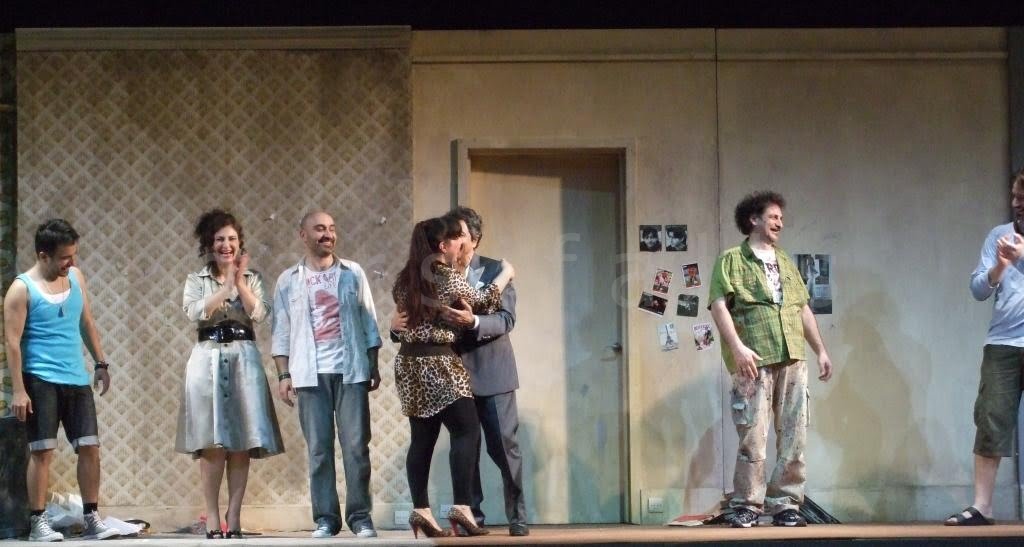
Curtain Calls:


After the performance I avoided to ask my friends for their impressions, I knew I would have time to do it once the experience had settled in them. However I was deeply moved when a colleague hugged me and said "I'm in shock, I have been having goosebumps for over 2 hours, I didn't expect that I would love it so much...".

Kyros Patsalides as Marcello

Lukia Spanaki as Musetta

Haris Adrianos as Schaunard

~.~

2 days later, I randomly
picked 4 of my colleagues that attended the event and asked them to write within just a sentence what they liked most and what they liked least.

The Verdict:

1) Female, in her 30's

Most: The tall bearded guy (*bass Tasos Apostolou*)
Least: His Birkenstocks

(The tall guy and his Birkenstocks)

2) Male, 30

Most: the magic on stage and the music
Least: Parts of the subtitles were at times hard to follow

3) Female, 28

Most: I loved the whole experience
Least: I found Rodolfo's attitude a bit weird during Act IV as it was discontinous to what had happened previously on stage (*in Vick's direction, Rodolfo stays away from Mimi during Act IV, no hugging, no kissing, no consolation, Rodolfo falls on his knees only to embrace Mimi's dead body*)

4) Female, 30

Most: the voices and the music
Least: the sets and my impression that the physical appearance of some singers did not match their character (*ha! she hasn't seen Caballé singing Salome*)

Obviously the looks DO matter (if there was a doubt). Hopefully there will be a sequel to this experiment and my friends will return to the Opera - with or without my involvement. Definitely it was a wonderful evening. Undoubtely the Greek National Opera deserves a future.

Tuesday, April 6, 2010

Opera in Greece: who cares, really.

In an article that carries the title “Given the crisis we will have to see if we maintain the Opera or not” Spanish newspaper La Vanguardia, presents a portrait of Greek Minister of Culture and Tourism, Pavlos Geroulanos.

Geroulanos, an economist who studied at the MIT and Harvard, spoke to journalist Justo Barranco about piracy, the Marbles and opera and made it quite clear that he's got absolutely no idea of what he's talking about...

¿Sufren cortes con la crisis?

Grandes, pero tenemos objetivos muy claros y canalizamos el dinero desde las áreas más ineficientes. Ahora tenemos un problema con la ópera y en los próximos días hemos de decidir si la mantenemos o no. Buscamos el modo de salvarla, queremos mantenerla abierta, pero se ha salido tanto del presupuesto que hay problema para hallar fondos e implica un enorme sacrificio. En cambio, el nuevo museo de la Acrópolis ha abierto una nueva manera de ver los museos en Grecia. Antes eran estáticos y éste es parte del estilo de vida de Atenas. Paseos, turismo, compras. Su éxito permite pensar con libertad en el patrimonio como algo no sólo a proteger sino a desarrollar.

Have you suffered abridgement of expenses given the crisis?

Many, but we have very clear objectives and we channel the money from the more inefficient areas. Right now we are dealing with a problem with the Opera and within the next days we will have to decide if we maintain it open or not. We are looking for a way to save it, we want to keep it open, but it has strayed
from its budget to such extent that there is difficulty to find the funds and it involves an enormous sacrifice. On the other hand [????!!!!] the new Acropolis Museum has opened a new way of perceiving the museums in Greece. In the past they were static and this is part of the life-style of Athens. Walks, tourism, shopping. The Museum's success permits us to think of the heritage not as something to protect but as something to develop.

Full interview can be found on the Sunday the 4th of April edition of La Vanguardia.

Tuesday, March 16, 2010

Musings on Traviata - with sound


My (english) friend Attila spent a few days in Athens and has kindly agreed to write a brief review of the Traviata he watched at the Greek National Opera on March the 14th.

Four years ago - at the time of the last football world cup - I saw Elena Kelessidi as Liú in Turandot at Covent Garden; if she didn't quite steal the show from Ben Heppner and Georgina Lukács, she certainly dominated that evening with radiant sublime singing that seemed to make time stand still and which drew the loudest applause of the evening.

Seeing her on Sunday in the current revival of La Traviata at the Greek National Opera in Athens, it's clear that time has diminished Kelessidi's voice. The glorious tone now eludes her and everything seems more of an effort. But her sheer artistry really shone as she worked that stage almost single-handedly amidst colleagues who at times looked like they were performing in an unrehearsed scratch performance. The mediocre static chorus seemed totally uninvolved in either the party or in the drama taking place in front of them, and the orchestra played with the refinement of a big band.


Fortunately, Kelessidi seemed to exist in a different dimension - every move had meaning, every note for all it's effort expressed her character's experience and suffering. For me, a master stroke of this production is that the last act doesn't take place in the usual spartan unfurnished garret but in the same splendid French empire setting of the Act 1 party. Kelessidi totally caught me by surprise as I found myself haunted by the eerie feeling that I was in present in the sumptuous Paris apartment of the dying Maria Callas at 36 Avenue Georges Mandel. I was witnessing the last days of a once great singer as she now slowly surrendered to disillusionment and mortality.


As one star fades another takes to the firmament. Dimitri Platanias shows a rich talent from the first moment he walks onto the stage as Giorgio Germont, handing his hat and coat to the waiting servant with a gravitas that sets the scene for his confrontation with Violetta. His solid frame brings a monumental quality to his scenes, and the voice purrs effortlessly like a Bentley V8 engine; so much so that at times I found myself revelling in the beauty of the tone without worrying what he was singing about. I sense there is plenty more to come from Mr Platanias.

Listen to Dimitri Platanias singing Di Provenza on

January the 22nd 2010

January the 23rd 2010


All photos (C) Akriviadis from the premiere of January the 22nd with Elena Kelessidi, Stefan Pop (a real find!) and Dimitris Platanias.


Thursday, March 4, 2010

Milk-Punch, o Wisky? Madama Butterfly opens in Athens


As expected, the premiere of Madama Butterfly of February the 26th at the Athens Megaron was a personal triumph for Chinese diva Hui He.

Hui He appeared extremely confident and excelled both vocally and dramatically. A voice of important volume, easy high notes, great fraseggio -still some flaws in pronunciation though- and a committed actress, He was sensational in every aspect, received a long applause after "Un bel dí" and was hair-raising in "Che tua madre" and "Tú,tú piccolo iddio".

Listen to Hui He singing "Un bel di"


Angelo Simos as Pinkerton sounded strained in the high register (Dovunque al mondo) and was shadowed significantly by Hui He, especially during the love-duet (Bimba dagli occhi). Furthermore, he appeared uncomfortable on stage and we couldn't help noticing that he didn't take his eyes off of the lateral conductor screens. Still, at times, especially during the most lyric bars of the score, a healthy shiny voice would emerge, unable though to erase the impressions.


Marissia Papalexiou was impressive dramatically and seemed to be the only one respecting 100% the instructions of Fausta Mazzucchelli who was responsible for the "choreography". Suzuki is a rather thankless role and doesn't give to the mezzo many chances to unfold her virtues, other than the duet with Butterfly and Act III but Papalexiou's dark mezzo suited perfectly the part and sang a powerful Suzuki. Thankless is also the role of Sharpless, but Dimitris Tiliakos was a credible and well sung Sharpless, however a bit on the dull side (an impression I have had of his last few performances in Athens).


Far duller was the staging by Nikos Petropoulos, a staging with the sole virtue of not offending the conservative audience: no nudity -thank God!- no blood, no real hara-kiri on stage, nothing extreme but also nothing new to recommend.

Two great Butterflies of the past honoured us with their presence:

Marina Krilovici

Jeanette Pilou

Tonight 3/3, Hui He sang her 3rd and last performance of Madama Butterfly in Athens and we can only wish to have her back soon in one of her other significant roles (Tosca, Aida, Amelia) or in something as surprising as her smashing Ariadne, a few months ago.

Hui He posing for parsifal's backstage

Hui He, Con onor muore...

A photo album from the curtain calls:

Sunday, February 14, 2010

False alarm


It seems tha chinese diva Hui He will finally sing 2 out of 5 scheduled performances of Madama Butterfly at the Athens Megaron, the premiere of 26/2 included.


Tuesday, February 9, 2010

Addio fiorito asil...


Parsi hears that chinese diva Hui He, has withdrawn from the upcoming run of performances of Madama Butterfly of the Greek National Opera at the Athens Megaron due to financial discrepancies with the theatre...

Sunday, January 10, 2010

A glimpse of the Athens Festival 2010


Parsi's hearing that the new production of the Greek National Opera for this year's Athens Festival will be NORMA, will take place (as always) at the Odeon Of Herodes Atticus and will feature no other than Dimitra Theodossiou in the title role (dates approx. 10-20 June 2010).


Saturday, December 26, 2009

The Young and the Rossinians


This year's annual production of the Athens Chamber Opera featured a weird double-bill: Poulenc's rarely performed cantata "Le bal masqué" and Rossini's one-act farsa
"L 'inganno felice".

I'm not really sure about the reasons that led to the staging of Poulenc's cantata and the truth is that I wouldn't mind skipping it. And this is exactly what I did in the second performance I attended.


I found the staging of L'inganno Felice by stage-director Niketi Kontouri, given the low budget of the Athens Chamber Opera production, quite succesful.
Kontouri chose to set the action in a bar, used video projections of legendary movies (Gilda, Casablanca etc.) and created a noir atmosphere where Isabella was our Gilda -though our Bertrando was no Rick Blaine.


In the performance of 19/12, Marianna Mansola, a student of the late Kostas Paskalis, was a treat for the eyes and the ears, an Isabella that displayed clear coloratura, good high notes, sense of the rossinian style, looked the part and sang an almost flawless "Al piú dolce a caro oggetto" dancing sensually on the bar, looking more of a Pfeiffer in The Fabulous Baker Boys than of a Hayworth.


Christina Poulitsi, dazzled the audience with her Isabella on December the 23rd, mainly by betting on vocal fireworks, and she did great. At times she would lose focus or would be off-pitch or flat, but here's a talent to keep an eye on. Her "Al piú dolce..." brought down the house and won the longest ovation of the evening.


Antonis Koroneos,(19/12) a "veteran" of the Greek National Opera in comparison to the rest of the cast, doing a come-back to the repertoire he ought to be singing, was a fine Bertrando, however with hints of weariness most probably due to an overloaded schedule.


Lionghua Hong (23/12), with a somewhat white and small voice was a correct yet unexciting Bertrando.


"The boyz", managed to be the vocal core of this production: Dionisos Tsantinis, a singer who 's already taken quite a few steps abroad (ex-student of Gabriele Schnaut at the University of Arts of Berlin, winner of the Schloss Rheinsberg 2008, and with appearances at the Staatsoper of Berlin most recently on his CV), displayed a healthy, beautiful voice, Dionisios Sourbis, a very promising singer was an enjoyable Batone, yet with some fuzzy coloratura and George Matheakakis (a singer with some very good reviews for his appearances abroad, "a real find", see here or here and here) did an excellent job as Ormondo, both vocally and dramatically.


Listen to:

Mansola in
"Al piú dolce ..." (the juicy part)

Poulitsi in
"Al piú dolce..." (the juicy part)